Showing posts with label statistics. Show all posts

Tuesday, May 15, 2012

Big Data for a Busy Library

Big Data for a Busy Library"Big Data” (i.e. very large data sets) is a hot topic lately in information technology.  With millions of items checked in and out each year across dozens of branches, your local library certainly has more than enough data to go around!


Enter collectionHQ. Last year, the King County Library System joined nearly 5,000 other libraries with its implementation of this software to assist each library branch with managing its collection.  The software is web-based (aka, “in the cloud”) so it can be easily accessed by library staff when data is updated monthly.

In addition to the common analysis one might expect, like top books and authors checked out, the software is also capable of helping the librarians understand what topics are popular in our library.  With this information, they can ensure the shelves are stocked with subjects in demand and relevant in our community.

There's probably still computers somewhere that run MS-DOS but still...The Redmond Library recently completed a weeding project to verify books that hadn’t been checked out in years were a) actually still on the shelf and b) otherwise ready to be retired.  It took nearly 6 months to analyze the Redmond branch collection and remove books that are under-utilized – called “dead” in library book parlance. 

You are 400 in line of 400 holds.Next, they will start analyzing specific topics to help ensure the books available are the ones that Redmond patrons want to check out. In addition, this data analysis tool allows staff to generate reports of “grubby” books – items that have been checked out so frequently they are probably worn out and in need of retiring. (The Hunger Games trilogy, anyone?)

Data is Cool.

Jaime

Saturday, May 12, 2012

Redmond Community Indicators 2012

Redmond Community Indicators is a tool for assessing progress toward achieving the eight broad community goals that underpin Redmond's Comprehensive Plan. The 2012 update was recently published, please see a selection of the highlights below.


GOAL: CONSERVE
(No Overall Trend)


Estimated Per Capita Water Consumption


Resource Consumption. The amount of waste per
single-family customer per week declined 3.5 pounds
to 55.3 pounds. The recycling rate among single family
customers decreased slightly to 62.4%. The
rolling three-year average water consumption fell
about four percent to 271 million cubic feet, the
lowest figure in at least nine years. Streams. All six
stream core sample sites have water quality index
scores greater than 40, which means that they are of
marginal concern or better. Two of eleven stream sites
given BIBI scores (“bug index” scores) rated above
35, the minimum required to support native habitat.


GOAL: COMMERCE
(Improving Trend)

Sales/Use & Property Tax Revenues


Businesses. There are 5,533 businesses licensed to
operate in Redmond: 958 are newly licensed while
1,445 have operated in Redmond for at least seven
years. Population and Employment. Redmond’s
population reached 55,150 in 2011 and employment
reached 76,876 (2010, latest available, not comparable
to prior years). Income and Poverty. Redmond
median household income rose to $95,038; the mean
wage rose to $110,182 (inflation adjusted). Child
poverty rose from 5% to 6.6% in the Lake Washington
School District (2010), the highest level in over 15 years.


GOAL: CULTURE
(Improving Trend)

Parks & Recreation Program Enrollment by Age Group


Recreation and Arts. The largest increase in
participation in City recreation program was among
those ages 5 to 12, while overall participation
increased to over 148,000. Events. About 24,000
people took part in Redmond Lights and Derby Days
combined in 2011 – about the same number as
participated in 2010. Over 44,000 participated in
arts-related performances and exhibitions in 2011.


Visit the City of Redmond’s Community Indicator page for complete details and access to historical annual reports.

Jaime

Friday, April 29, 2011

Redmond Community Indicators 2011: Where are We Headed?

On April 27th, the City of Redmond released its sixth annual Redmond Community Indicators report.City of Redmond logo These reports monitor the city’s progress towards achieving the goals laid out in Redmond Comprehensive Plan developed in 2005. The report focuses on a variety of indicators that highlight economic, cultural, and demographic trends

The full set of reports are available on the City’s website — see Redmond Community Indicators. The Redmond Community Indicators Brochure 2011 provides a good summary of the full report. Here are a few of the indicators highlighted:

Estimated Per Capita Water Consumption

Street Trees

Size of New Single-Family Homes

Downtown & Overlake Employment

Redmond Library Board

Monday, February 7, 2011

Jaime’s KCLS Jaunt: By The Numbers Summary

King County - All Points Visited!For me, part of the fun of any travel is all of the research and planning that goes on before I even step out of the front door!  I took a look at my trusty spreadsheet to see what “interesting” facts I could share about my year in library travel.

Barely Basics  
Places Visited: 51
Distinct Trips: 29
Average Libraries/Trip: 1.76
Approximate Miles: 604
Carbon Offset Donation: $10*
   
Dig in for more Details  
Solo Trips: 12
Trips with Others: 26
Trips with my Mom!: 1**
Library Staff Met: 31 (at least)
Photos Taken: 537
   
Quirky Counts  
New Breakfast Places: 6
Parts Wheelie Lost: 2***
Pies Purchased: 2
Round-trip Ferry Rides: 1
Closed Libraries, Counted: 1****

A good spreadsheet goes a long way!

Jaime

p.s. It turns out I have one more Jaunt blog post to come…saying “Thank You” will take paragraphs!

*More than enough.  604 miles is less than $2.
**It had been…decades…since my mom was in a library.  Seriously.  She was amazed at the DVD collection.
***Wheel and water bottle!
****Redmond Ridge.  But I’ve been there before.

image12

Saturday, December 25, 2010

Washington State by the Numbers: The 2010 Census Results

Initial 2010 Census results are now available. The Census Bureau has recently released the resident population Census 2010: WA Population Changefor the nation and states, as well as congressional apportionment totals for each state. For Washington state, the population increased 14.1% during 2000-2010.

Click on the following image to display an interactive map that provides details on each state’s population change, population density, and apportionment. 

Click to view interactive map

Beginning in February and wrapping up by March 31, 2011, the Census Bureau will release demographic data to the states on a rolling basis so state governments can start the redistricting process.

Other key Census Bureau references include:
  • Interactive Timeline  Lists census planning efforts, major milestones, and census data announcements over the next several years.
  • Multimedia Center  Features video, photo, and audio showcasing the importance of the 2010 Census.
  • Census in Schools  Features classroom activities and teaching materials to help teachers and students learn about the importance of the Census.

Redmond Library Board

Saturday, March 27, 2010

Opportunity For All: How the Public Benefits from Internet Access at U.S. Libraries

Nearly one-third of Americans age 14 or older – roughly 77 million people – used a public library computer or wireless network to access the Internet in the past year, according to a recently released national report.click to view the full report - Opportunity For All In 2009, as the nation struggled through a recession, people relied on library technology to find work, apply for college, secure government benefits, learn about critical medical treatments, and connect with their communities.

The report, Opportunity for All: How the American Public Benefits from Internet Access at U.S. Libraries, is based on the first, large-scale study of who uses public computers and Internet access in public libraries.Opportunity For All It also looks at the ways library patrons use this free technology service, why they use it, and how it affects their lives. It was conducted by the University of Washington Information School and funded by the Bill & Melinda Gates Foundation and the Institute of Museum and Library Services.

Making libraries more accessible has spurred library usage. In the King County Library System, the mini-libraries in the Crossroads Mall in Bellevue and the Southcenter Mall in Tukwila generate heavy traffic and usage.

KCLS Library Connection @ Southcenter

Those of us in the Redmond area are indeed fortunate to have a rich variety of services offered at the Redmond Library. Take advantage of the opportunity!

Redmond Library Board

Wednesday, February 17, 2010

Census 2010: Why We Count

Census 2010 logo The U.S. Census counts every resident in the United States, and is required by the Constitution to take place every 10 years. The 2010 Census will help communities receive more than $400 billion in federal funds each year for things such as:
   • Hospitals
   • Job training centers
   • Schools
   • Senior centers
   • Bridges and tunnels 
   • Emergency services

The data collected by the census also helps determine the number of seats your state has in the U.S. House of Representatives. It’s quite possible that Washington, which currently has 9 congressional seats, may pick up an additional seat. All the more reason why every person counts.

In March of 2010, census forms will be delivered to every residence in the United States and Puerto Rico. When you receive yours, just answer the 10 short questions and mail it back. To find out more, see United States 2010 Census.

Census 2000 Figures for Redmond
You can find detailed 2000 Census information for your community by accessing the U.S Census Fact Sheets. To view the Redmond Fact Sheet, use the 98052 zip code. This fact sheets contain a wealth of demographic information, such as the percentage breakdown by age group of the 50,249 residents of Redmond.

Census 2000: Redmond residents by age groups

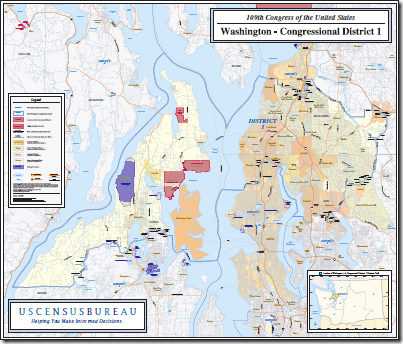
The Census Bureau Web site also includes demographic information about congressional districts at Fast Facts for Congress. Detailed maps for congressional districts are also available, such as the one for Washington’s Congressional District 1 (includes Redmond).

Congressional District 1 - Washington

Redmond Library Board

Saturday, February 21, 2009

Engage: Redmond Library 2009 Community Study

Every year KCLS selects several of its member libraries to provide an an in-depth study of its community library service area. The study provides details about the community’s history and demographics. The study also provides recommendations for improved library services.

Redmond Library 2009 Community Study Members of the Redmond Library staff, Debra Westwood (Cluster Manager) and Chris Livingston (Site Manager), presented the Redmond Library 2009 Community Study to the KCLS Library Board of Trustees on January 27, 2009. The theme of this study is Engage. You can find on online version of this document at Redmond Regional Library 2009 Community Study.

Demographics
The current population of the City of Redmond, 51,320. Redmond continues to draw young families due to the relatively strong job market and available housing. The largest demographic is between 25 and 54 years of age, both single, single with children, couples and couples with children. The median age is 35.

Redmond Library Community Study: population by age

What perhaps is unique about Redmond is the influx of immigrants who come from all over the world to work in the high-tech industry, often bringing their families with them, including parents. Redmond Library 2009 Community Study There are also numerous Spanish-speakers who are attracted to the library’s many programs and services. The library has proved to be a natural gathering place — a neutral, welcoming oasis that, at times, appears to be a miniature United Nations.

Library Services
The Redmond Library is the second busiest KCLS library after Bellevue. The library has a collection of about 188,000 items and circulates more than a million items a year. More than 500,000 people visit the library annually. There are about 60,000 adult patrons and 10,000 minors registered to the Redmond Library, but the library attracts patrons from all over King County, including residents of Seattle who work in Redmond.

Summer Reading Program: Catch the Reading Bug Children are an important audience for the services of the Redmond Regional Library. The children’s librarians provide services and school visits to 15 schools in the Redmond Regional Library’s service area. Many families from several neighboring schools, not in our service area, visit and use the Redmond Regional Library regularly. This is reflected in program participation. Of all KCLS member libraries, Redmond has the highest number of participants in Ready, Set, Read and the second highest number of sign-ups for the Summer Reading Program, with more than 2,500 children in 2008.

For information on other current library services and recommendations for improved library services, see the full report at Redmond Regional Library 2009 Community Study.

Other Blog Postings on Community Studies
Here’s a list of other Redmond Library blog postings on community studies:

Communities Count 2008: Social & Health Indicators Across King County
Sound Transit’s Plans for Redmond
City of Redmond: Pedestrian Program Plan
Redmond Community Indicators 2008

Redmond Library Board

Tuesday, January 20, 2009

Communities Count 2008: Social & Health Indicators Across King County

Communities Count 2008 The Communities Count 2008 report provides an updated picture of the quality of community life across King County. The report details 38 indicators, each highlighting a social, economic, health, environmental or cultural condition that matter most to King County families and communities. Communities Count is a collaborative initiative between key public and private organizations within King County.

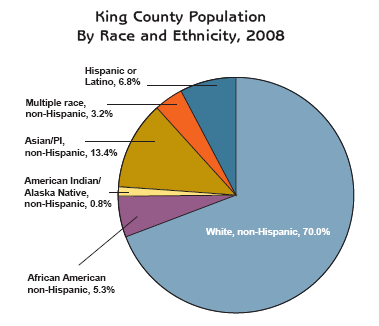
The Introduction section of the Communities Count 2008 report provides a good overview of the goals and process used to obtain data. It also provides a demographic profile of King County. For example, the following graph from this section shows King County population by race and ethnicity:

King County population by race and ethnicity

Community Indicators
Community Count 2008Indicators measure conditions valued by our communities. Indicators help leaders make informed funding and policy decisions, as well as motivate residents and community stakeholders to take action. The Community Count 2008 report is divided into 6 major categories of indicators:

  - Basic Needs & Social Well-Being 
  - Positive Development Through Life Stages
  - Safety & Health
  - Community Strength
  - Natural & Build Environment
  - Arts & Culture


Strong communities are informed communities, and the Community Count 2008 report goes a long way towards educating us about our neighbors.

Other Blog Postings on Community Studies
Here’s a list of other Redmond Library blog postings on community studies:

Engage: Redmond Library 2009 Community Study
Sound Transit’s Plans for Redmond
City of Redmond: Pedestrian Program Plan
Redmond Community Indicators 2008

Redmond Library Board

Saturday, July 12, 2008

Washington Trends: Population growth

Washington TrendsThe Washington Trends section of the Office of Financial Management Web site provides a wealth of demographic information for Washington state. The statistics on population growth are of particular interest, since Washington state continues to increase in population.

Population Change
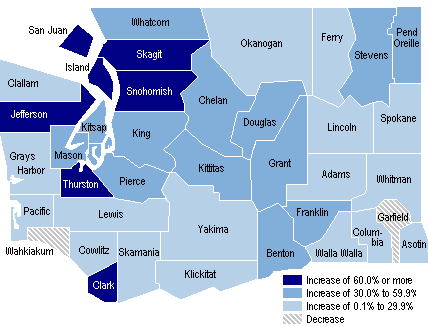
The following map shows the percentage changes in population in Washington state counties from 1980 to 2000, and is based on U.S. Census Bureau data:

Population change - 1980 to 2000

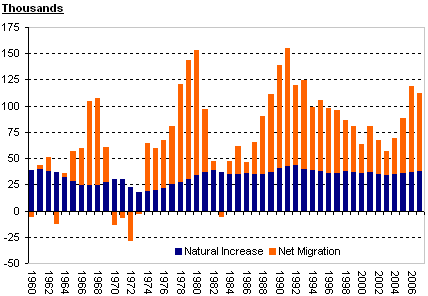
Population growth is comprised of two major components — natural increase and net migration. In the early 1990s, the poor economic climate in California resulted in over 400,000 persons migrating out of state. Many of these people moved to Washington state, which accounts for a large spike in population growth during the 1990s, as shown in the following chart:

Population Change and Net Migration

For more information on Washington state population statistics, see Population in Washington Trends.

Monday, June 23, 2008

Redmond has 7,004 trees on its streets

Redmond neighborhoodLearn about other facts and figures in the Redmond Community Indicators 2008. This third edition of the Redmond Community Indicators, is now available online at Redmond 2022. This year, you can either access each indicator individually, or view the entire set in the Annual Report 2008. Redmond Community Indicators is a tool for the community at large, elected officials, boards, commissions, and City staff, to monitor progress toward implementing the Redmond Comprehensive Plan.

Here are some of the interesting figures about the City of Redmond provided in this year's indicators:

Redmond Community Indicator figures 
For more information about the above figures, go to Redmond 2022.

Other Blog Postings on Community Studies
Here’s a list of other Redmond Library blog postings on community studies:

Engage: Redmond Library 2009 Community Study
Communities Count 2008: Social & Health Indicators Across King County
Sound Transit’s Plans for Redmond
City of Redmond: Pedestrian Program Plan

Redmond Library Board

Monday, June 9, 2008

City of Redmond facts

City of Redmond Redmond is the 7th most populous city in King County and the 16th most populous city in the State of Washington, with a residential population of approximately 50,680 in 2007. It encompasses an area of over 16.85 square miles and is located less than 20 miles east of downtown Seattle at the north end of Lake Sammamish.

The City of Redmond Web site contains a number of interesting facts about our city. Did you know that there are 5,539 students within the Redmond city limits that go to Lake Washington School District schools? The following graph shows the breakdown by type of school as of 10/07:

Redmond students in LWSD schools
You can find more information on Lake Washington School District by clicking here. You might want to check out the School District Calendar for 2008-2009 -- it lists all the key dates (holidays, half-days, parent-teacher conferences) for the school year starting next fall.