Showing posts with label art. Show all posts

Friday, October 31, 2014

An Unexpected Tour

I had a chance to visit Chicago, the Windy City, a couple months back.  It was a short trip and I didn't get a chance to really prepare for the trip.  Once I landed, I decided to walk around and admire the architecture the city had to provide.  I came across an older building with the words "Public Library of the City of Chicago" etched into the side.

-You can barely see the etching in this picture-

I didn't want to miss this opportunity on seeing a new library in a new city and decided to hop across the street.   


 -Just waiting for the light to change so I can cross the street-

As I entered through the entrance, I was surrounded by tiled and marbled walls.  It was breathtakingly beautiful and I had to take a moment to soak it all in.

 
I noticed some quotes on the wall within the tile.  Lots of inspiring quotes etched into the walls.


Strangely enough, I started noticing that there were no books in the library I was taking pictures of.  As it turns out, I was actually not in the library!  It was actually the cultural center located within the building.  Talk about feeling embarrassed as I had not noticed until I reached the top floor.  I guess the beauty of the tile and marble had thrown me for a loop.

Ultimately, while it wasn't the library like I thought it would be, it was still a fun little unexpected tour of something I would have just walked by.  So just a little lesson, if you see something interesting, head to it, give it a shot.  If it ends up being something you were not expecting, then even better.  Take in the experience. :-)

  - James


Wednesday, May 21, 2014

Ice Books

New Mexico “eco-artist” Basia Irland creates and distributes “ice books,” ice sculptures made of frozen river water with seeds embedded inside. The ice sculptures are then placed into bodies of water throughout the world, distributing the material as the ice melts away.

Ice book

Each project begins by carving frozen river water into the form of a book.  Some books are large and weigh as much as 250 pounds; others are the size of a pocket book. Each is embedded with an “ecological language” or “riparian text” consisting of local native seeds. The book is then placed back into the stream.

Closed books have seed patterns on the covers, while open books have rows of seeds forming sentences and paragraphs. These seeds are released as the ice melts in the current. Where the seeds choose to plant themselves is serendipitous, replicating the way seeds get planted in nature.

A young girl “reads” ice-book text comprised of Fremont cottonwood seed (Populus fremontii) beside the Rio Grande in Albuquerque, New Mexico.

Reading an ice book

There have been ice book projects locally in Washington state at the Nisqually and Skookumchuck Rivers. Here’s an ice book containing snow berries. It was released into the Nisqually River in 2008.

Ice book made of snow berries

ornamental_line
Lorin Catudio 
Redmond Library Board, Emeritus

Tuesday, January 1, 2013

Siouxland Libraries

First, Happy New Year!  I hope that everyone has enjoyed their 2012 holiday season and is looking forward to a grand start to 2013.

As part of our holiday traditions, we visit my husband’s [large extended] family in South Dakota on even-numbered years in mid-December.  This is our 7th visit over the years, and if you can believe it, the first time I’ve visited a library in the City of Sioux Falls library system – Siouxland Libraries! The City has a wonderful historic downtown filled with sculpture and brick buildings and my destination was the main library branch building (constructed in the 70s), as well the former Carnegie library building, now the Carnegie Town Hall

Carnegie Town Hall - Front

Carnegie Town Hall - Rear

The Carnegie building, constructed of a native stone called rose quartzite, was used from 1903 to 1972 as the library, then housed various art-related functions, and since 2001 has been the Town Hall with the City Clerk and Council chambers plus a few other City departments. Since we were visiting during a Friday afternoon the building was open and when we peeked in, we were lucky enough to receive a short tour from the super friendly City of Sioux Falls City Clerk.  She pointed out a few features of the original building and showed us the state-of-the-art council chambers – it was quite a treat for a little special attention.

Library Sculpture

Our next stop was the current main library branch, decorated festively for the holidays. My mother-in-law was with me for the afternoon field trip and since she works close by, she’s been a frequent visitor over the years.  She described to me all of the changes to the floor plan as well as reminisced about bringing the grandchildren over the years to story times on Saturday morning.  I know how popular the story times are at KCLS, so wasn’t surprised they were just as fun in her library system too!

Library Book Holiday Tree

From the main library, it was just a hop, skip, and a jump to The Old Courthouse Museum, part of the Siouxland Heritage Museums collection.  My favorite exhibit was either the cold weather clothing or the bicycles – both provided interesting views into days gone by.

As you know, visiting libraries isn’t complete for me unless it’s also accompanied by sampling the local cuisine.  Oh My Cupcakes! rounded out our leisurely downtown strolling afternoon quite nicely.

Wishing you all the best in the coming New Year!

Cupcake!

Jaime

Wednesday, March 7, 2012

The Show Must Go On: Cavalia Pulls Up Its Tents

Cavalia ended its 6-week run at Marymoor Park in Redmond last weekend. Several days later, the 110’ tall main tent was all that was left to take down.

Cavalia main tentHere are some fascinating statistics about the main tent:

  • Size of canvas for the tent is 71,000 square feet
  • Seating capacity is 2004 persons
  • Width of the stage is 160’
  • Stage contains 2,500 tons of sand and dirt

Eight other tents form part of the Cavalia village. These auxiliary tents are used for such things as a stable and an employee cafeteria. In the photo below, only the tops of one the auxiliary tents remain to be dismantled.

Cavalia auxillary tents150 people are required to erect the tents and work on the preparation of the site. The set-up takes 12 days, while the tear down is completed in three days. Cavalia now moves to St. Louis where the entire setup/tear down cycle is repeated.

The video below, Building Cavalia, walks through the creation of the Cavalia village.

Cavalia banner draped on a stack of freight containersOh, and that large Cavalia sign on Highway 520, that was actually a banner draped on a stack of 5 freight containers the containers are conveniently used for storage.

Redmond Library Board

Monday, March 5, 2012

A Wall of Words: Full Book Posters from Spineless Classics

What a great idea! The words of an entire book printed on a single sheet of paper…

Alice in Wonderland poster (measures 28" x 20")

Spineless Classics now has over 60 titles to choose from, including Beowulf, Peter Pan, and Pride and Prejudice. Each poster contains the complete text of the book, with the words arranged as decorative graphics. Surprisingly, the Beowulf postersmall-sized text, which uses a 4-point font, is legible.

The brainchild of Carl Pappenheim, the idea of book text as wall art came to him by accident one year when he was too broke to buy expensive Christmas gifts. Despite his poor finances, he wanted to give his mother a present that meant something. He collaborated with an architectural drawing company, and printed the text of her favorite novel on a poster.

And if reading the words on these posters isn’t enough of a challenge for you, there’s Spineless Classics new line of jigsaw puzzles. You guessed it the puzzle image is the complete text of a book.

Alice in Wonderland poster puzzle

Redmond Library Board

Sunday, November 13, 2011

America by Design: Posters from the WPA 1936-1943

The By the People, For the People: Posters from the WPA, 1936-1943 collection consists of 908 boldly colored and graphically diverse original posters produced from 1936 to 1943 as part of Franklin Roosevelt's New Deal. Of the 2,000 WPA posters known to exist, the Library of Congress collection of more than 900 is the largest.

By the People, For the People: Posters from the WPA, 1936-1943These striking silkscreen, lithograph, and woodcut posters were designed to publicize health programs, cultural programs, travel and tourism, educational programs, and community activities. The posters were made possible by the Federal Art Project, whose primary goal was to employ out-of-work artists. The project administrators believed that art should be part of the daily lives of all Americans, not just the elite. Even though there were diverse approaches to poster design, the WPA collection embodies a truly original American poster style.

The Posters
Here are some of the Collection Highlights. The following 1936 poster is from the Tenement House Department of the City of New York. The poster promotes better living conditions by keeping tenement neighborhoods clean. Notice the expressive use of bold colors and lines.

Help your neighborhood by keeping your premises clean : Tenement House Dept. of the City of New York

The following poster is a 1936 poster announcing the second annual photograph exhibition of the Sioux City Camera Club. Note the stylized simplicity of the man and his camera, echoing the streamlined curves of the then popular Art Deco style.

Second Annual Exhibition of the Sioux City Camera Club

Before the advent of television, posters were widely used as public service announcements. The follow poster promotes eye examinations for children.

John is not really dull - he may only need his eyes examined

Some of the most striking WPA posters are ones that promote travel and tourism. The follow poster, showing two bighorn sheep, highlights America’s national parks. Many of the posters were produced by the silkscreen printing process, which allowed graphic artists to create rich layers of colors and textures.

The national parks preserve wild life

And of course, libraries and reading were also promoted.

A year of good reading ahead

This extraordinary collection of posters from the 1930’s continues to influence modern designers today.

Redmond Library Board

Thursday, August 18, 2011

The Colorful Past of Old Russia: Prokudin-Gorskii's Photo Collection Reconstructed

Almost all photos from around the early 20th century are in black and white. However, Sergey Mikhaylovich Prokudin-Gorskii, a pioneering Russian photographer, developed an ingenious photographic technique for generating color images. His color images, reconstructed from his original glass negatives, provide an extraordinary look at early 20th-century Russia. You can find his photos as part of the Library of Congress online exhibit, The Empire That Was Russia.

Isfandiyar, Khan of the Russian protectorate  of Khorezm

The Russia of Nicholas II on the eve of World War I was a land of striking ethnic diversity. Comprising all of the republics of what later was to become the Soviet Union, as well as present-day Finland and much of Poland, Russia was home to more than 150 million people of which only about half were ethnic Russians. In his travels throughout the empire, Prokudin-Gorskii captured this diversity.

Dagestan is a Russian republic in the North Caucasus region on the Caspian Sea. Here is an image of Dagestani women around 1905:

Dagestani women

Another image shows an Armenian woman in her national costume:

Armenian woman in national costume
Daily Life
In the early 1900s Prokudin-Gorskii formulated an ambitious plan for a photographic survey of the Russian Empire which won the support of Tsar Nicholas II. Between 1909-1912, and again in 1915, he completed surveys of eleven regions, traveling in a specially equipped railroad car provided by the Ministry of Transportation. One of Prokudin-Gorskii’s goals was to capture the daily life of the Russian people.

The following image shows a Russian family resting in a hay field during harvest time:

Harvest time in a Russian wheat field

Another image shows Jewish children with a teacher in Samarkand, Uzbekistan:

Jewish children with teacher in Samarkand
Another image taken in 1910 shows a family working at a pit mine in Bakalskii, which is in the Bakaly Hills of the Ural Mountains:

Family working at Bakalskii mine
Color Photographic Technique
Prokudin-Gorskii's process used a camera that took a series  of three monochrome pictures in sequence, each through a different-colored filter. Each negative contains the color value for each RGB component. In Photoshop terminology, these 3 images represent RGB channels. In fact, adventurous Photoshop users have recreated Prokudin-Gorskii's color images by combining the digitized versions of the RGB negatives as layers with specific channel values.

Monochrome negatives containing RGB values

results in

Bukhara emir 
Given the complex process of printing color images at the Three lens projection lantern time, Prokudin-Gorskii often displayed his images using a special projection lantern with three lenses. By projecting all three monochrome negatives using the correct colored light, and then overlapping the images, he was able to reconstruct the original color scene.

Library of Congress Exhibits
The Library of Congress offers a wide range of online exhibitions featuring treasures from its own collections as well as the treasures of other national libraries. Here are some of the current exhibits available online:

Redmond Library Board

Friday, June 24, 2011

Word Play with Word Clouds: Redmond, Jabberwocky, and Green Eggs and Ham

Word clouds, popular as Web navigation aids, can now be easily created for your own custom visual designs using a new generation of free Web tools. The most popular word cloud design tools are: Tagxedo, Wordle, Wordlings, and Tagul

Tagexdo
Tagxedo turns words — famous speeches, news articles, even your resume — into a visual word cloud. A word cloud (or tag cloud) displays words that are individually sized to represent the importance or frequency of occurrence within a body of text.

Here’s a word cloud that uses part of the text of the Wikipedia entry for the City of Redmond. As you might expect, “Redmond” is the most prominent word. You can set options to ignore common words, such as “the” or “a”.

Redmond Wikipedia word cloud (click for larger image)

Here are the words of the Lewis Carroll poem, Jabberwocky, overlaid onto an image of a dragon. With Tagxedo, you can use standard images to contain your text, or upload your own image files.

Jabberwocky word cloud (click for larger image)

Wordle
Wordle is a Java-based word cloud generator, in which all words have equal weighting. You can tweak your clouds with different fonts, layouts, and color schemes. Here’s a word cloud based on all the words in the text of the children’s book, Green Eggs and Ham.Green Eggs and Ham word cloud (click for larger image)Green Eggs and Ham, written by Dr. Seuss, contains a vocabulary of only 50 different words, which is far less than the more chatty The Cat in the Hat, which uses 225 words.

Wordlings
Wordlings is the simplest of the word cloud generators. Just enter a line of text and your word cloud starts forming, by repeating the words of your text.

Books word cloud (click for larger image)

Tagul
Tagul is an interactive word cloud Web service that allows you to create hyperlinks for each of the words in the word cloud. Here's an interactive word cloud (requires Flash) that contains links to the home pages all of the member KCLS libraries. Try clicking on the library names.


Get Adobe Flash player


Redmond Library Board

Thursday, May 26, 2011

The Eyes Have It: Artwork Along the East Lake Sammamish Trail

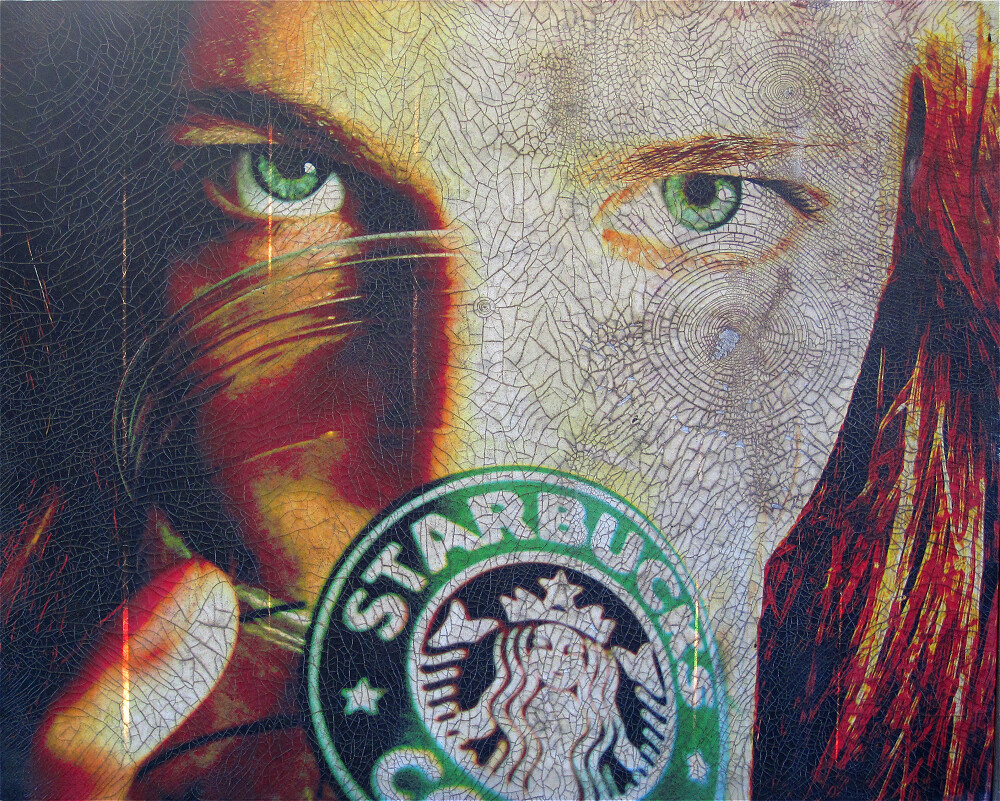
I was being watched while riding my bike along the East Lake Sammamish Trail! The green eyes peered out of a large photo mounted on a fence along the trail. The face looked eerie, as several years of weathering have created fracture patterns on the wood.

Girl and coffee (click for larger image)Sammamish photographer and digital artist, Jim Wolfe, displays his prints along the fence in front of his house as well as his neighbor’s house. 

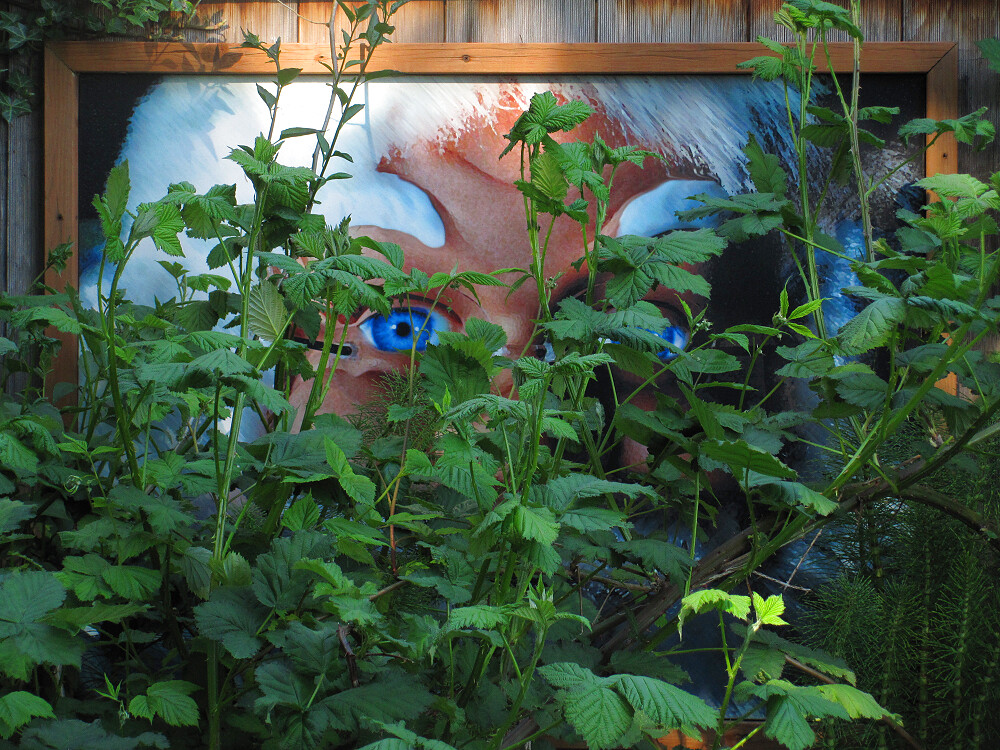
Fence art trio (click for larger image)Several years ago, Jim figured out a technique to print digital images on non-paper surfaces, such as canvas and wood. One of his earliest artistic themes was faces, and you’ll find plenty of them staring at you. One print peeked out at me from behind blackberry bushes.

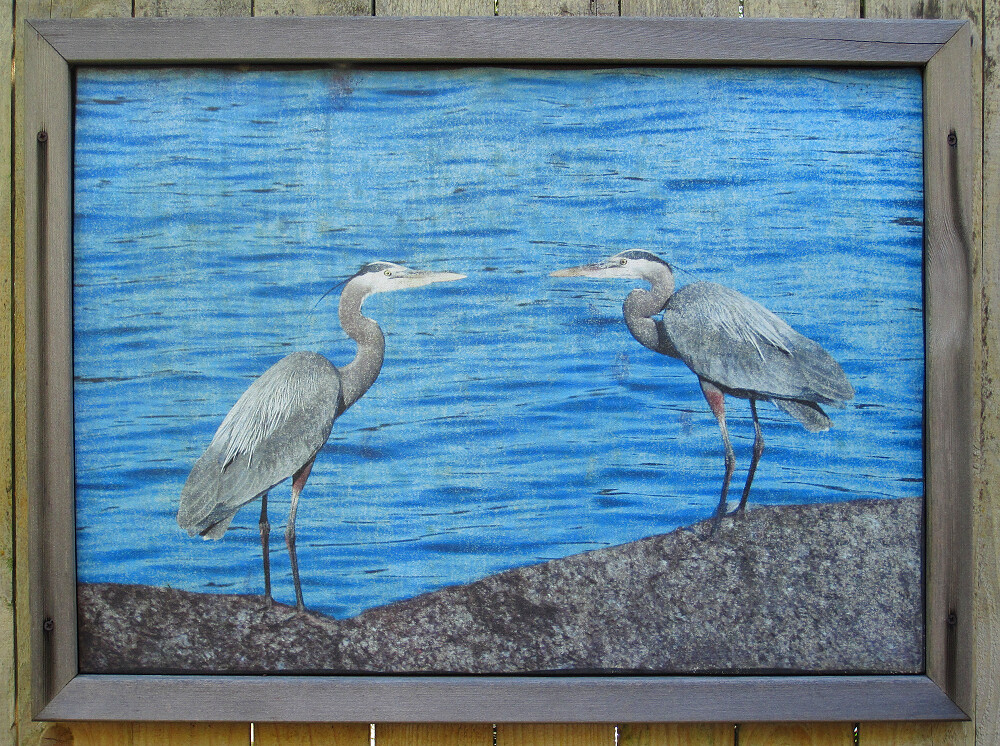
Artwork behind plants (click for larger image)Jim’s later artistic themes included nature scenes, such as the following print of two herons.

Two heron (click for larger image)

At one time, Jim tried selling his prints in downtown Seattle. While people appreciated his artwork, most people were more interested in figuring out how to duplicate his process rather than buying his artwork.

East Lake Sammamish Trail 
East Lake Sammamish Trail map To view the artwork along the trail, travel about 4 miles south from Marymoor Park along the East Lake Sammamish Trail until you reach 1103 East Lake Sammamish Parkway NE.

For more info on King County regional trails, see Regional Trails System.

Redmond Library Board