Wednesday, March 7, 2012

The Show Must Go On: Cavalia Pulls Up Its Tents

Cavalia ended its 6-week run at Marymoor Park in Redmond last weekend. Several days later, the 110’ tall main tent was all that was left to take down.

Cavalia main tentHere are some fascinating statistics about the main tent:

  • Size of canvas for the tent is 71,000 square feet
  • Seating capacity is 2004 persons
  • Width of the stage is 160’
  • Stage contains 2,500 tons of sand and dirt

Eight other tents form part of the Cavalia village. These auxiliary tents are used for such things as a stable and an employee cafeteria. In the photo below, only the tops of one the auxiliary tents remain to be dismantled.

Cavalia auxillary tents150 people are required to erect the tents and work on the preparation of the site. The set-up takes 12 days, while the tear down is completed in three days. Cavalia now moves to St. Louis where the entire setup/tear down cycle is repeated.

The video below, Building Cavalia, walks through the creation of the Cavalia village.

Cavalia banner draped on a stack of freight containersOh, and that large Cavalia sign on Highway 520, that was actually a banner draped on a stack of 5 freight containers the containers are conveniently used for storage.

Redmond Library Board

Tuesday, March 6, 2012

The Rise of 3D in Online Animations

PlusOne AmsterdamAnimated GIF images and Flash animations are rapidly becoming a relic of the past. Over the last several years, the Web has seen a growing number of visually rich animations using hi-def video formats and sophisticated 3D techniques. There are two main reasons for this:

GreenBullet_1 With the proliferation of high bandwidth Internet access, larger streams of richer content can be downloaded.
GreenBullet_2 The animation techniques that video game developers use are becoming mainstream for all content.

PlusOne Amsterdam, a Dutch production studio, is in the forefront of developing visually rich animations. Their content  creates an immersive experience for viewers. The implications for educational content in the future are enormous. Try viewing short examples of their work below.

BTW, I viewed these videos fullscreen in 1920x1080 screen resolution they looked awesome!

Amsterdam DNA
The Amsterdam Museum's new exhibit takes you on a three-dimensional 45-minute journey through the Dutch capital’s history. Notice how adding depth to the animation brings it alive.

NCB Naturalis
NCB Naturalis, a recent merger of three institutes, is the Dutch center for excellence for biodiversity studies.

TED2011 Official Opening Film
The opening promo for the TED conference in Amsterdam, entitled "The Rediscovery of Wonder. There’s a lot of eye candy here.

For more examples of Plus One Amsterdam content, see PlusOne's videos on vimeo.

Animation Software
PlusOne Amsterdam uses the following software for designing and creating content:

Autodesk 3Ds Max Suite for modeling, animation, rendering and compositing.
Maxon Cinema4D for high-end 3D rendering
Adobe Creative Suite for general purpose graphics design and editing

Redmond Library Board

Monday, March 5, 2012

A Wall of Words: Full Book Posters from Spineless Classics

What a great idea! The words of an entire book printed on a single sheet of paper…

Alice in Wonderland poster (measures 28" x 20")

Spineless Classics now has over 60 titles to choose from, including Beowulf, Peter Pan, and Pride and Prejudice. Each poster contains the complete text of the book, with the words arranged as decorative graphics. Surprisingly, the Beowulf postersmall-sized text, which uses a 4-point font, is legible.

The brainchild of Carl Pappenheim, the idea of book text as wall art came to him by accident one year when he was too broke to buy expensive Christmas gifts. Despite his poor finances, he wanted to give his mother a present that meant something. He collaborated with an architectural drawing company, and printed the text of her favorite novel on a poster.

And if reading the words on these posters isn’t enough of a challenge for you, there’s Spineless Classics new line of jigsaw puzzles. You guessed it the puzzle image is the complete text of a book.

Alice in Wonderland poster puzzle

Redmond Library Board

Sunday, March 4, 2012

Preserving Treasures After a Disaster: A Survival Guide for Books, Photos, and other Damaged Materials

RainyWeatherIconWater and dampness, so common in the Northwest, wreak havoc with many of our prized possessions, especially paper-based items. Fortunately, there are many online references for how to salvage damaged items. The Preserving Treasures After a Disaster resource on the Library of Congress Web site provides an excellent set of guidelines for salvaging items affected by water, contamination, mold, smoke and soot.

On air-drying books using a portable fan…

Fan drying a water-damaged book

Books that are half wet have the best result when air-dried. Fan books open and stand on top or bottom edge; never stand them on the front edge. Stand books on driest edge first as it is the strongest. As the book dries, turn it upside-down to the opposite edge every few hours.

Other items, such as photos, negatives, and documents, can simply be hung up to dry on a clothesline:

Drying water-damaged items on a clothesline

Other sections of the Web site cover protecting and preserving Family Treasures. For those who want to preserve a cultural slice of time, there’s even a section on Creating a Family Time Capsule.

How To Salvage Videos
Preservation Australia, a museum conservation and preservation services company, has posted a series of YouTube videos that demonstrate a number of techniques for salvaging water damaged materials, such as books, documents, photographs, and even textiles.

Here’s the step-by-step video entitled, Salvage of Water Damaged Books:

and its sequel, Air Drying Techniques for Water Damaged Books:

Hopefully, you’ll never need to perform these tasks, but if you do, there are plenty of resources for you to use.

Redmond Library Board

Saturday, March 3, 2012

A Collective Memory: American Treasures of the Library of Congress

United States Flag (1814)In 1814, Francis Scott Key wrote new words for a well-known drinking song, To Anacreon in Heaven, to celebrate America's recent victory over the British. However, only on March 3, 1931 (following a twenty-year effort during which more than forty bills and joint resolutions were introduced in Congress) was a law finally signed proclaiming The Star Spangled Banner to be the national anthem of the United States. Happy 81st birthday! 

The American Treasures of the Library of Congress collection contains a copy of the first printed edition of our national anthem one of only ten copies known to exist.
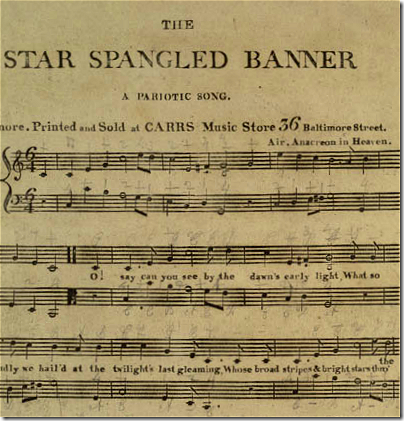
Star Spangled Banner sheet music

BTW, before 1931, My Country, ‘Tis of Thee, whose melody is identical to the British national anthem, served as our de facto national anthem.

American Treasures
The American Treasures of the Library of Congress online exhibition contains the rarest, most interesting, or significant items relating to America's past. This includes items, such as the Original Rough Draught of the Declaration of Independence and Lincoln’s First Draft of the Gettysburg Address.

Other exhibits in the American Treasures collection are more obscure, such as the Huexotzinco Codex. The Huexotzinco Codex is an eight-sheet document on amatl, a pre-European paper made in Mesoamerica. It is part of the testimony in a legal case against representatives of the colonial government in Mexico, ten years after the Spanish conquest in 1521.

Huexotzinco Codex (click for larger image)

Historic Photos
The Prints and Photographs Division of the Library of Congress contains a huge archive of photos one of the crown jewels of the American Treasures collection. The 1930s-40s in Color exhibition is a dramatic set of color photos from the Great Depression and World War II that capture an era generally seen only in black-and-white. It’s astonishing to see how much more powerful these images are in color.

The following photo shows a family at the Vermont State Fair in Rutland (1941). Notice the girls’ homemade dresses are made from the same bolt of cloth very common and very practical in those days.

At the Vermont State Fair, Rutland (1941)The next photo shows a small store with live fish for sale in Natchitoches, Louisiana (1940).

Fish for sale in Natchitoches, Louisiana (1940)The next photo shows two men on a mule-drawn wagon fertilizing an oat field in Georgia (1940). Despite the widespread introduction of farm machines throughout the country, mules and horses were still commonly used for farm labor.

Fertilizing an oat field in Georgia (1940)And finally, the last photo shows a woman operating a hand drill on a Vengeance dive bomber in a Vultee-Nashville aircraft factory (1943). With so many men in uniform during World War II, large numbers of women worked in factories.

Woman working on a dive bomber (1943)Photographers working for the United States Farm Security Administration (FSA) and later the Office of War Information (OWI) created these images between 1939 and 1944.

Redmond Library Board

Friday, March 2, 2012

Happy Birthday Dr. Seuss!

The Cat In The HatThe most famous children’s book writer of all time, Dr. Seuss, would have been 108 today. Theodor Seuss Geisel, who called himself Dr. Seuss, wrote over 40 children’s books during his life, which have sold more than 200-million copies. Some of his most famous books include The Cat in the Hat, How the Grinch Stole Christmas, Green Eggs and Ham, Oh The Places You Will Go!, and Horton Hears a Who!

In May 1954, Life magazine published a report on childhood illiteracy, which concluded that children were not learning to read because their books were boring. Accordingly, a director of Houghton One Fish Two Fish Red Fish Blue FishMifflin compiled a list of 348 words he felt were important for first-graders to recognize and asked Geisel to cut the list down to 250 words and write a book using only those words.
Nine months later, Geisel completed The Cat in the Hat, using 236 of the words given to him. It was imaginative with simple drawings and strong verse rhythms but most of all, it could be read by beginning readers.

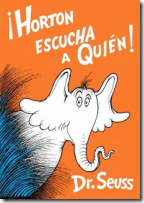
¡Horton Escucha a Quién!The Cat in the Hat and subsequent books written for young children achieved huge international success and they remain very popular today. In 2009, Green Eggs and Ham sold 540,366 copies, The Cat in the Hat sold 452,258 copies, and One Fish Two Fish Red Fish Blue Fish sold 409,068 copies — outselling the majority of newly published children's books.


Green Eggs and Ham
Green Eggs and Ham, written by Dr. Seuss, contains a vocabulary of only 50 different words, which is far less than the more chatty The Cat in the Hat, which uses 236 words. Here’s a word cloud (created by using Wordle) based on all the words in the text of Green Eggs and Ham.Green Eggs and Ham word cloud (click for larger image)

Read Across America Day 
Geisel's birthday, March 2, has been adopted as the annual date for National Read Across America Day, an initiative on reading created by the National Education Association.

Read Across America 

Redmond Library Board

Thursday, March 1, 2012

Our Architecture Legacy: The Stories Old Buildings Tell Us

Join historic preservation lecturer, Michael Herschensohn, for a talk on how Michael Herschensohnarchitecture reflects our culture. The talk is at the Redmond Library on Saturday, March 17th at 1pm. Michael Herschensohn has a degree in Preservation Planning and History of American Architecture. For 21 years he has been on the board of Historic Seattle, the city’s only historic preservation organization. This program is made possible by a grant from Humanities Washington.

Seattle Central Library (1919) Seattle Central Library (1919)

The places we create for ourselves homes, factories, schools, parks, hotels, barns are key markers in the story of people’s daily lives. Understanding the structure of these Redmond Centennialplaces helps us interpret human experience and foster greater appreciation for the past. In this Redmond Centennial Discovering History program, Michael Herschensohn examines historic buildings from across the state, with special emphasis on Redmond. By looking carefully at old buildings we can begin to understand the similarities and differences between the past and our contemporary lives.

Seattle Central Library (2004) Seattle Central Library (2004)

Historic Seattle
Historic Seattle believes that buildings provide an essential link to the past, reminding us of who we are and where we came from. Historic Seattle 2012 ProgramsFounded in 1974, Historic Seattle is the only nonprofit membership organization dedicated to preserving Seattle and King County's architectural legacy. Its mission is to educate, advocate, and preserve.

For 2012, Historic Seattle provides a variety of tours, lectures, and special events that will expand your view of the Seattle area and give insights into its architectural delights. See the Events Calendar for details.

Redmond Library Board